Inside a Fully Connected Wealth Advisory Tech Stack
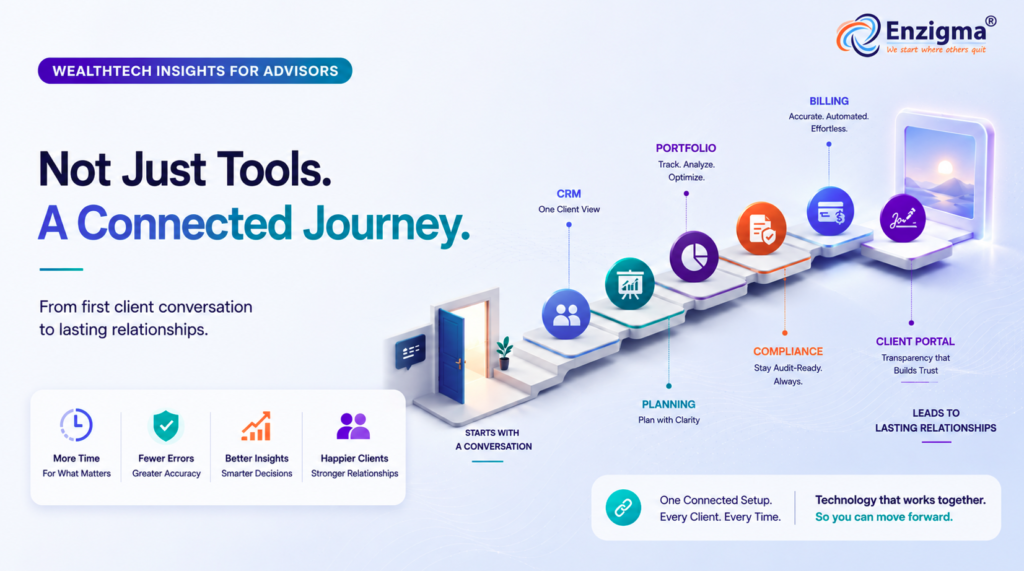
Quick Answer – A fully connected wealth advisory tech stack links every core system, so client data flows from one to the next without manual work. The CRM sits at the center. Planning, portfolio, compliance, billing, and the client portal all pull from it. One update reaches every tool at once.
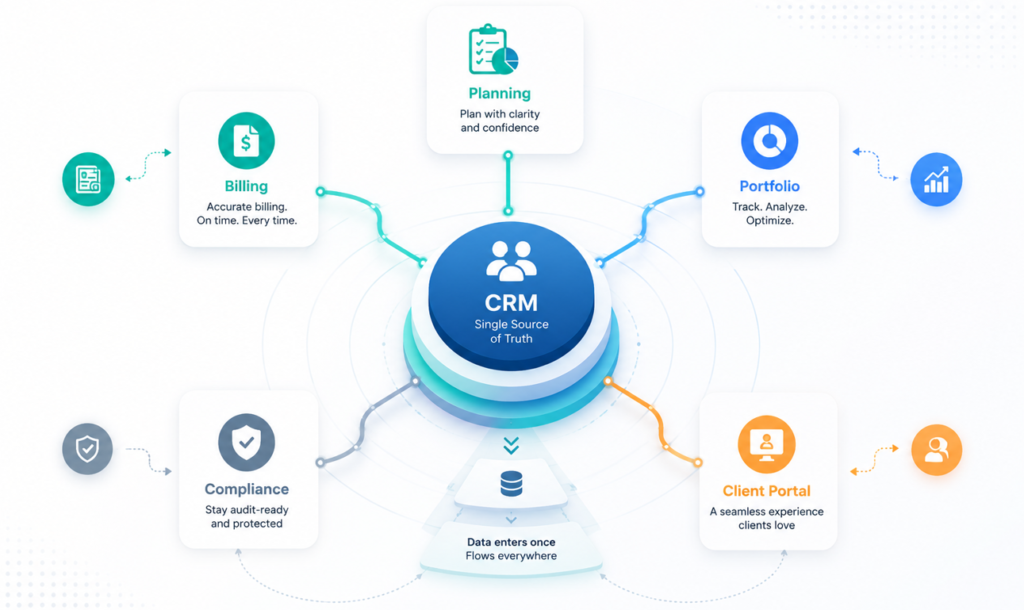
What does a truly connected firm look like from the inside? It is not a single mega-platform. It is just the everyday tools, linked so they share one source of truth. So let us walk through it, system by system. This is what a well-built wealth advisory tech stack actually looks like.
The CRM sits at the center
Everything starts with the Customer Relationship Management (CRM) system. It holds the master client record.
In a connected setup, the CRM is not just a contact list. It is the hub. Every other tool reads from it and writes back to it. That is why advisors rank the CRM as their most valuable software (T3 / Inside Information 2026 Survey). Around 91 percent of firms use one.
Planning pulls from the same record
The financial planning tool sits next to the CRM. When a client detail changes, the plan updates with it. There is no re-entry.
About 83 percent of advisors use planning software (T3, 2026). In a connected stack, that tool never works from stale data.
Portfolio and reporting stay in sync
The portfolio system tracks accounts and performance. Overnight, it reconciles with custodian data on its own.
So when advisors arrive in the morning, the numbers already match. Client reports then pull straight from these connected systems. What took an afternoon now takes minutes.
Compliance writes itself as work happens
In a connected setup, the compliance record is a by-product of normal work. When a client signs a form or an advisor logs a meeting, the audit trail updates on its own.
This keeps the firm ready for Securities and Exchange Commission (SEC) and Financial Industry Regulatory Authority (FINRA) review, without a last-minute scramble.
Billing runs from real account data
The billing tool reads account values straight from the portfolio system. So fees calculate on accurate numbers. There is no copying figures across tabs.
The client portal brings it together
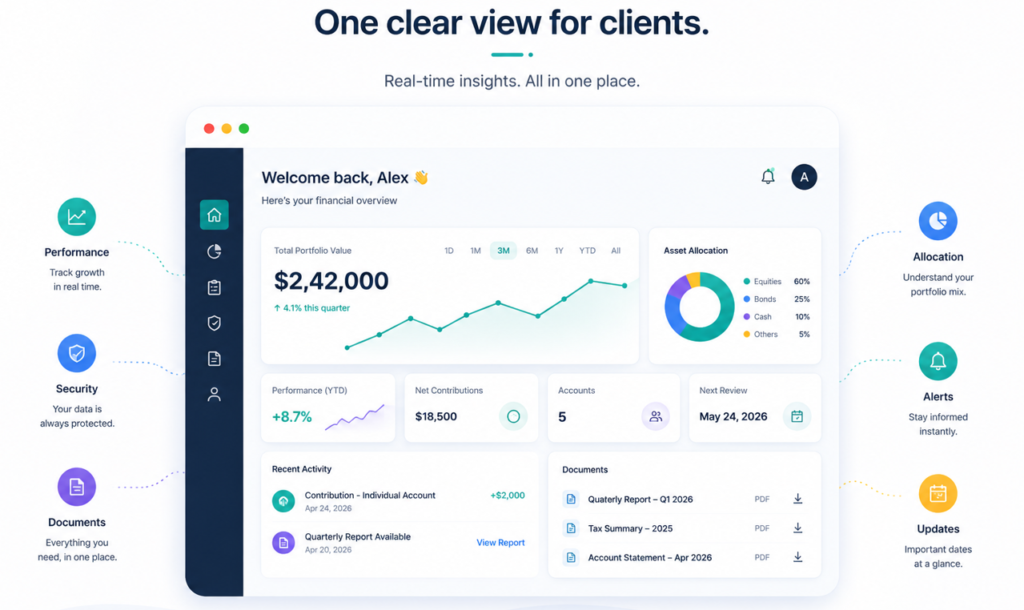
The client portal is where clients see it all. Because it draws from connected systems, what clients see is always current.
That builds trust. And a strong digital experience keeps clients longer.
The thread that ties it together
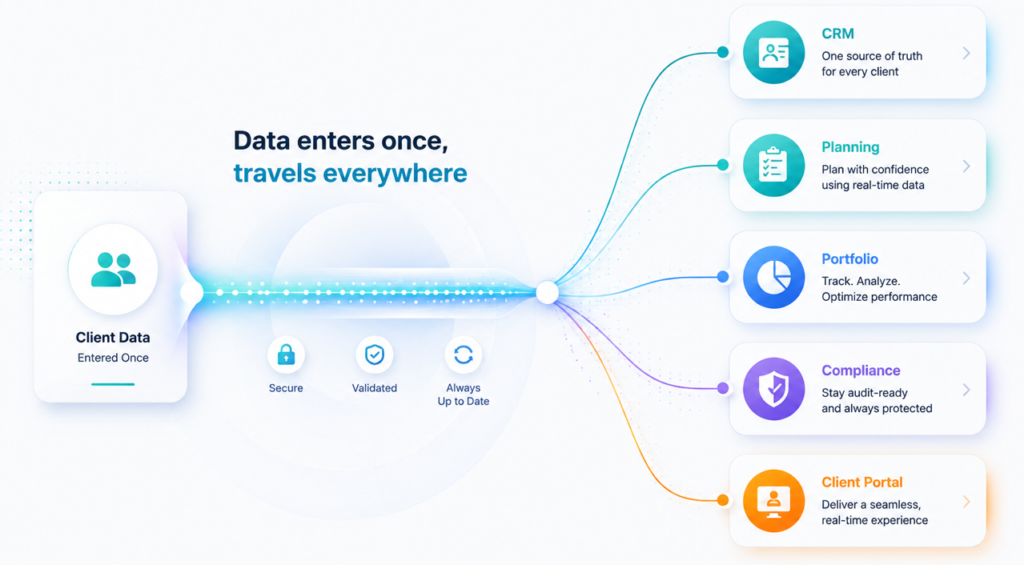
Notice the pattern. Data enters once and travels everywhere. No tool works alone.
That is the whole idea of a connected wealth advisory tech stack. It is not more software. It is better links between the software you already have.
A Few Quick Questions Advisors Ask Us
- What tools belong in a wealth advisory tech stack?
At a minimum: a CRM, a planning tool, a portfolio system, a compliance tool, billing, and a client portal.
- Does the CRM have to be the center?
In most firms, yes. The CRM holds the master client record, so the rest of the stack builds around it.
- Do we need to replace tools to connect them?
Usually not. Most firms connect the tools they already own. A connected wealth advisory tech stack is not a dream reserved for large firms. Smaller firms often feel the benefit fastest.
The tools are already on your desk. Connecting them is what turns seven systems into one.
That is a full setup, from the CRM to the client portal. This wraps up our look at what good looks like. Next, we move into practical guides you can use inside your own firm, starting with a simple technology audit.
About Enzigma Solutions –
Enzigma works with independent wealth advisory firms and Registered Investment Advisers across the United States. We build exactly this kind of connected setup, using the tools firms already own. See how Enzigma helps firms at enzigma.com/solutions/fintech.