Why Your Wealth Advisory Firm Wastes 15 Hours a Week
It is 8:47 on a Tuesday morning. Your first client call is at 9:30. You already have three browser tabs open from three different systems you logged into before your coffee was done. Your operations lead is pulling together the portfolio report for today’s review, because the portfolio tool and the planning tool do not share data – and that report does not build itself.
The meeting will go well. It usually does. But somewhere between 4:00 PM today and 8:00 AM tomorrow, someone on your team will have spent another two hours entering the same client data into a second system, reconciling a spreadsheet that should reconcile automatically, and building another document that three different tools already contain the pieces of. This is not unusual. It is the normal Tuesday at the average independent Registered Investment Advisor (RIA) firm in the United States.
In our experience working with advisory firms, much of this effort can be reduced significantly with the right setup and workflows.
The Breakdown Nobody Talks About
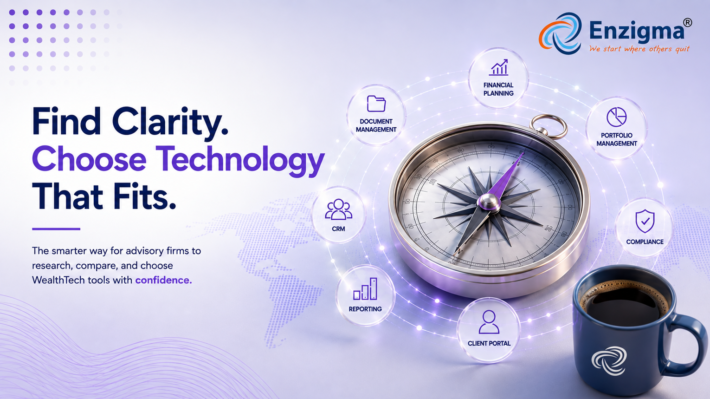
The typical independent advisory firm today runs on five to seven separate software tools. Each one was added at a specific moment, for a specific reason, by someone solving a specific problem. The Customer Relationship Management (CRM) software to track clients. The financial planning tool to build plans. The portfolio management platform to track performance. Document management for paperwork. An e-signature tool for client approvals. One or two custodian portals depending on where client assets are held.
Every tool does its individual job reasonably well. Most of them are good products. The problem is not the tools.
The problem is that none of them were designed to talk to each other. Data that exists in one system has to be manually moved to the next. When something changes in one place, someone has to update it in all the other places too. And between every pair of systems that are not connected lives a person – doing the work a data connection should be doing.
That person is usually your most experienced, most expensive team member. And that work is taking 15 hours of their week.
Where Does the 15 Hours Actually Go?
Let me be specific, because “15 hours” sounds like a large general claim until you map it to real tasks.
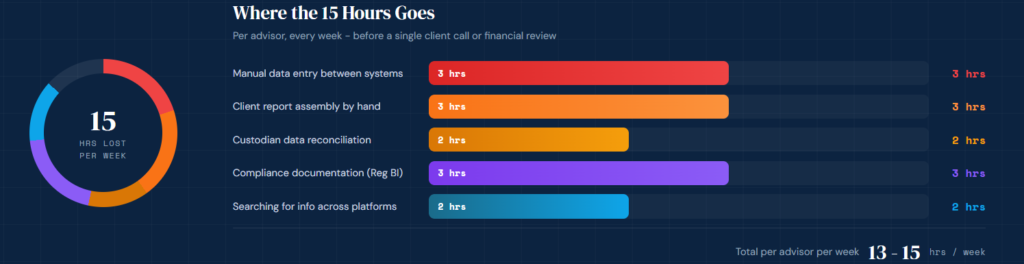
Manual data entry and duplication – roughly 3 hours a week. Client information lives in the CRM. The financial planning tool needs it too. So someone copies it across. When it changes on one side, someone updates both. No one built a bridge between them, so a person became the bridge.
Client report preparation – roughly 3 hours a week. Before each quarterly review, someone spends the better part of an afternoon pulling figures from the portfolio platform, formatting them, combining them with planning notes from a separate tool, and assembling a document by hand. A report that could take minutes is taking hours because the source systems do not feed a single output automatically.
Custodian data reconciliation – roughly 2 hours a week. The custodian portal shows one number. The internal portfolio tracker shows another. The gap needs to be found, explained, and corrected. Manually. In a spreadsheet.
Compliance documentation – roughly 3 hours a week. Regulation Best Interest (Reg BI) and SEC requirements mean advisory firms need documented trails of recommendation reasoning. Most firms do this in a separate system that has no live connection to where actual client activity happens. So compliance records become a reconstruction effort after the fact, not a real-time record.
Searching for information across systems – roughly 2 hours a week. Which tool has the current version of this client’s investment policy statement? Is the contact in the CRM up to date? Where is the most recent meeting note? Across five or six platforms, the answer is never immediately obvious.
That is 13 to 15 hours. Per advisor. Per week. Gone before anyone has done a minute of actual financial advisory work.
What This Is Costing Your Firm Every Year
At this point, this becomes a financial conversation rather than just an operational one.
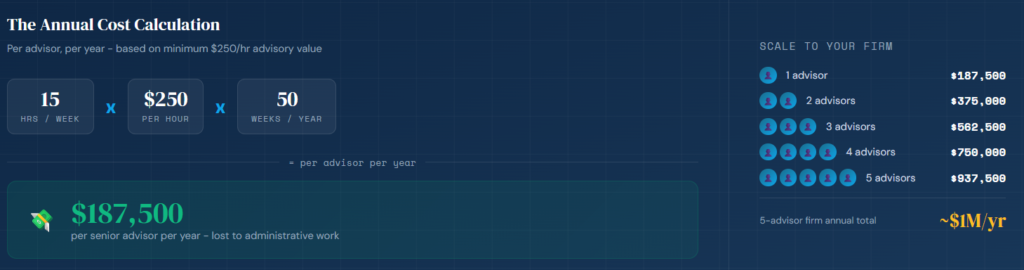
A senior advisor’s time is worth at minimum $250 per hour when measured against the value they generate from client-facing work. At 15 hours per week lost to administrative tasks, that is $3,750 per week per advisor. Over 50 working weeks, that is $187,500 per advisor per year.
For a five-advisor firm, that is close to $1 million annually in advisor-equivalent time spent on work that software – properly configured – should be handling.
The tools cost money. The licenses and subscriptions are real budget items. But the tools themselves are not the biggest line item. The people managing the gaps between the tools are.
Most firms treat this as a normal cost of running a business. It is not. It is the cost of running a business on technology that was never properly connected.
This Is Not a People Problem
The natural response to this kind of workload is to hire more people.
Operations load too heavy? Add an operations associate. Compliance falling behind? Bring in a compliance coordinator. Reports taking too long? Add an analyst.
But none of those hires fix the underlying issue. They add more people to manage the same gaps. And as the firm grows, the number of tools grows too. Each new addition, a risk tolerance platform here, a tax planning module there, creates another island without a bridge. Every hire quietly becomes someone whose real job is being a human data connector between systems that were never configured to connect themselves.
The firms that have genuinely solved this have not done it by growing their support headcount. They have done it by connecting the tools they already paid for.
What Changes When the Tools Are Actually Connected
Here is what the same workday looks like at a firm whose technology stack is properly integrated.
- The CRM updates a client record. That update flows automatically to the financial planning tool, the compliance log, and the document system. Nobody copies anything.
- Custodian data reconciles overnight as an automated process. When advisors arrive in the morning, the numbers already match.
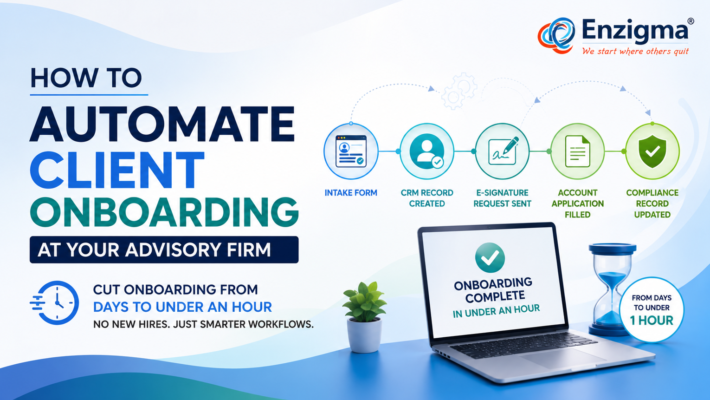
- A new client completes an intake form. Simultaneously, the CRM record is created, a DocuSign e-signature request is sent to the client to sign the intake documents, and a compliance review case is automatically created. One action, three results.
- Client reports are pulled directly from connected systems, formatted automatically, and ready in minutes – not assembled over an afternoon.
- Compliance documentation is captured as a natural by-product of the work happening in other systems. The audit trail writes itself.
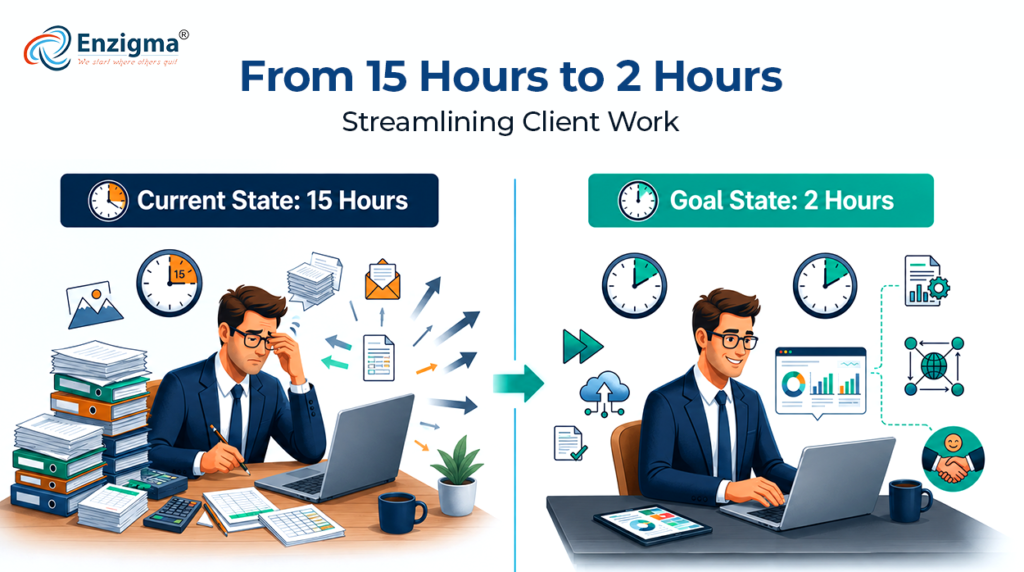
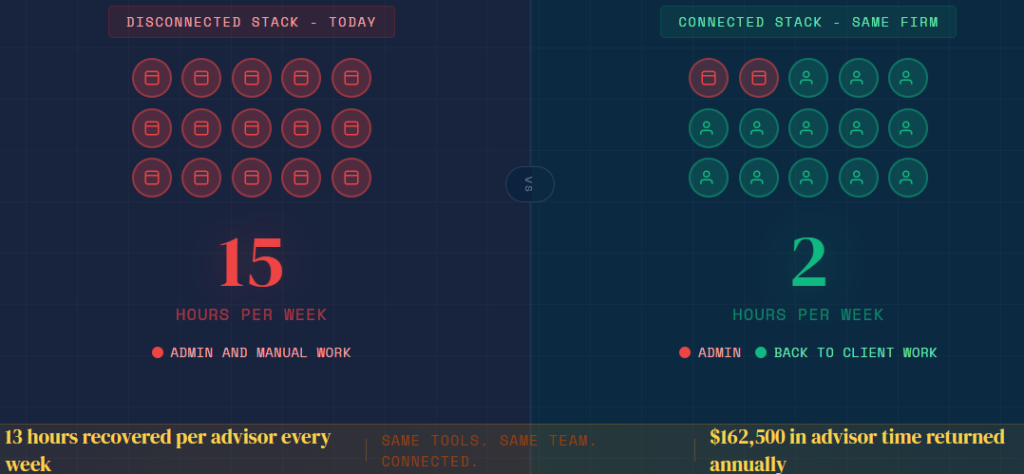
The same 15 hours of work becomes 2. Not because the work disappeared – because the work is now being done by the systems, not by the people.
The Question Worth Sitting With
When was the last time someone sat down with your technology setup and asked not “do we have the right tools” but “are the tools we have actually working together”?
For most independent advisory firms, the honest answer is that tools were chosen at different moments, by different people, and were never connected to one another. That is not a failure of strategy. It is what happens when technology gets added reactively as a firm grows, rather than as part of a considered architecture.
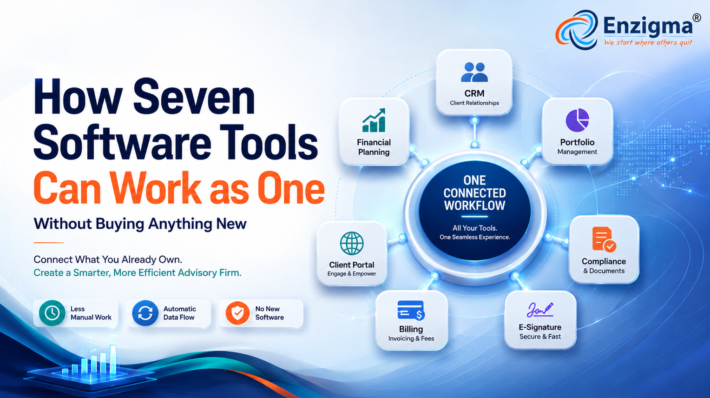
The good news is that the tools are rarely the problem. Most firms already have what they need. What is missing is the connective layer – the configured workflows, the integrated data flows, the automated handoffs that make five separate tools behave as one coordinated system.
Building that layer does not require replacing what you have. It does not require a full-time technology hire that a growing firm cannot yet justify.
Next week in this series: What a fully connected advisory technology stack looks like in practice – and what it realistically takes to get there. If this question has been sitting in the back of your mind, you are in exactly the right place.
About Enzigma Solutions
Enzigma works with independent wealth advisory firms and Registered Investment Advisors across the United States to implement, configure, and connect their technology stacks – without requiring firms to replace their existing tools or hire a full-time technology team. If you are exploring what this kind of setup looks like for a firm like yours, the work we do is detailed at our WealthTech Solutions page.