Your Advisor CRM Is Only Using 20% of Its Power
Ask any advisory firm if they use a CRM and almost all of them will say yes.
Quick Answer:
Independent financial advisors adopt CRM software more than any other category of advisor technology. But most firms use their advisor CRM only as a digital contact list. The workflow automation, task triggers, and reporting features built into most advisor CRMs go almost entirely unused.
CRM software has the highest adoption rate of any advisor technology category, according to recent industry research. More advisors use a CRM than any other single piece of software in their stack.
But ask what they actually use it for. The answer is almost always the same: storing contact details and writing the occasional note after a call.
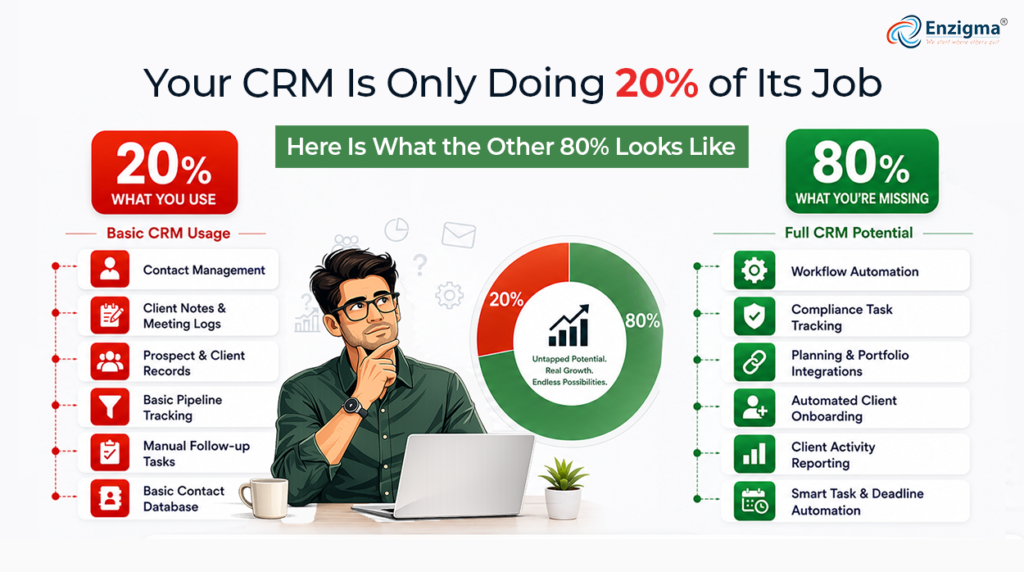
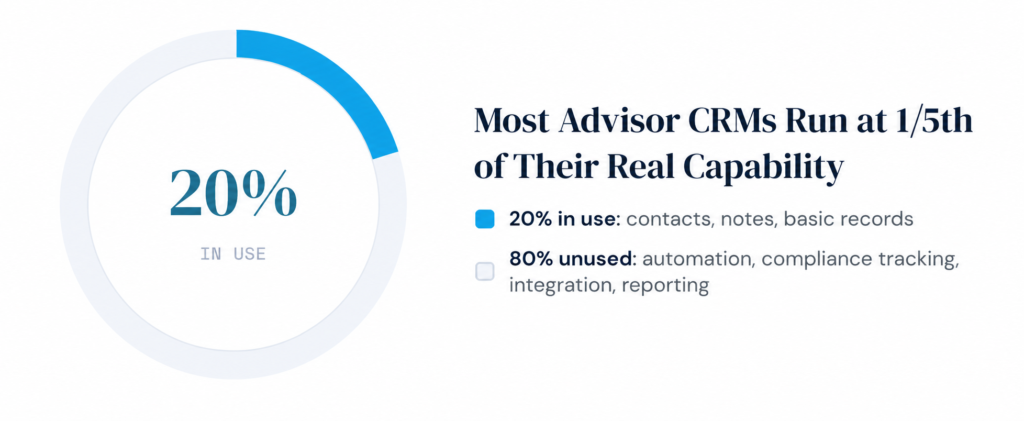
That is roughly 20 percent of what a modern advisor CRM is actually built to do.
What Most Firms Use Their CRM For Today
- Storing client names, emails, and phone numbers
- Logging notes after meetings and calls
- Keeping a basic record of who is a client and who is a prospect
This is useful. It is also the most basic layer of what an advisor CRM can offer. Most firms stop here and never go further.
What Other 80 Percent Actually Looks Like
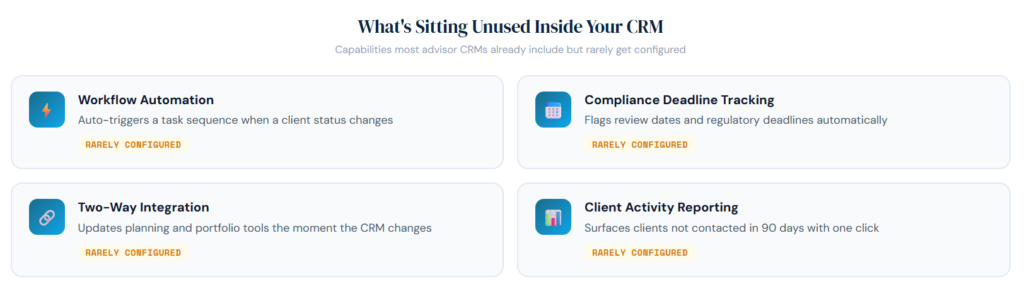
- Workflow automation. Most advisor CRMs can automatically trigger a sequence of tasks the moment something changes. A new client signs on. An account crosses a certain size. Almost none of this gets configured.
- Task and deadline tracking tied to compliance. An advisor CRM can flag exactly when a client review is due. It can flag a regulatory deadline too, without anyone checking a calendar by hand.
- Two-way integration with planning and portfolio tools. When a CRM is properly connected to your planning software, updating one system automatically updates the other. Most firms still update each system separately, by hand.
- Built-in reporting on client activity. Many advisor CRMs can show exactly which clients have not been contacted in 90 days, or which prospects went cold. Few firms ever turn this feature on.
Why This Gap Exists in the First Place
This is not a failure on the part of advisory firms. CRM platforms like Wealthbox and Redtail ship with dozens of features that take real time to configure properly.
Most firms set up their CRM once, during onboarding, and never go back to enable the more advanced features. The CRM works, technically. It just works at a fraction of its real capability, quietly, in the background, for years.
What a Fully Configured CRM Actually Saves You
When the other 80 percent gets switched on, the impact shows up quickly.
- New client onboarding tasks trigger automatically instead of relying on memory
- Client reviews are flagged before they become overdue
- Data entered once in the CRM updates your planning and portfolio tools without anyone touching a keyboard twice
- Reports that used to take an afternoon to assemble now take minutes
A Quick Look at What Becomes Possible
Picture a new client signing on with your firm. With a fully configured advisor CRM, that single signature kicks off a chain of events automatically. A welcome task gets assigned to the right team member. The financial planning tool receives the client’s information without anyone retyping it. A compliance checklist opens itself, already populated with the client’s details.
None of this requires new software. It only requires switching on capability that is already sitting inside the advisor CRM your firm pays for every month.
Now picture the same moment without that configuration. Someone manually creates the contact. Someone manually opens the planning software and re-enters the same details. Someone remembers, hopefully, to start the compliance file. Three people, three separate actions, one client.
The advisor CRM did not change between these two pictures. What changed is whether anyone took the time to set it up properly.
A Simple Way to Check Your Own CRM
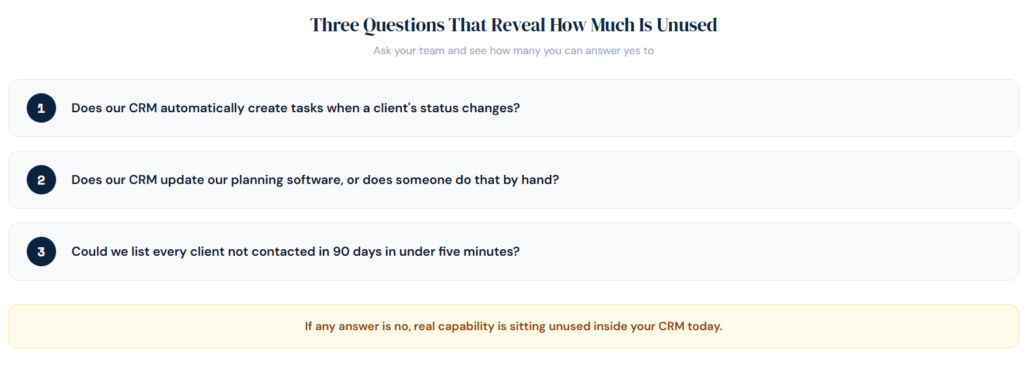
Ask your team three questions.
- Does our CRM automatically create tasks when a client’s status changes?
- Does our CRM update our planning software, or does someone do that by hand?
- Could we pull a list of every client we have not contacted in 90 days right now, in under five minutes?
If the answer to any of these is no, there is meaningful unused capability inside your advisor CRM. Your firm is already paying for it every month.
A Few Quick Questions Advisors Ask Us
- What CRMs do most financial advisors use?
Wealthbox and Redtail are among the most widely used CRM platforms among independent advisors, according to recent advisor technology research.
- Do we need to switch to a new CRM to fix this?
Almost never. Most of what is missing is configuration, not a new platform.
- How long does it take to properly configure a CRM?
Most firms can have core workflow automation running within a few weeks once the configuration work begins.
Next week in this series: we look at what a fully connected advisory technology stack looks like once your CRM, planning tool, and portfolio platform are finally working as one system.
About Enzigma Solutions
Enzigma works with independent wealth advisory firms and Registered Investment Advisors (RIAs) across the United States to help them get the most from their CRM, planning, and portfolio tools. If your team relates to the 20% usage pattern described above, explore our WealthTech solutions to see how we can help.