Why Advisory Firms Hit a Growth Ceiling Early
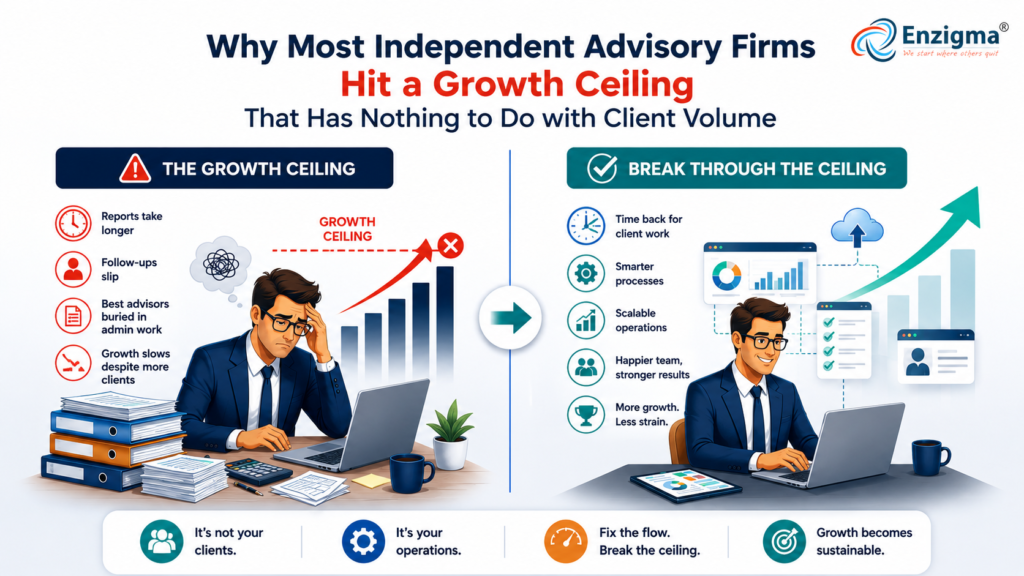
Your firm added five new clients this quarter. Good news, right? But your team is more stressed than ever. Reports take longer. Follow-ups slip. Your best advisor is now buried in admin work instead of meeting clients.
This is the growth ceiling. And here is the strange part: it has very little to do with how many clients you have.
Quick Answer
Most advisory firms hit a growth ceiling long before they run out of clients to serve. The real limit is usually the firm’s own operations. Processes that worked fine at $100 million in assets often break down by $300 million or $500 million, simply because nobody redesigned them as the firm grew. The fix is rarely “hire more people.” It is almost always “fix how the work flows.”
What a Growth Ceiling Actually Looks Like
A growth ceiling rarely announces itself. It shows up as small frustrations that quietly pile up. Meetings take longer to prepare for. Client questions take longer to answer. New hires take longer to get up to speed, because nothing is written down the same way twice.
None of this means your firm is doing badly. It often means the opposite. You are growing. But the systems underneath that growth were built for a smaller firm, and they are starting to show the strain.
Why More Clients Is Not the Real Problem
It is tempting to think a growth ceiling is about client volume. More clients, more work, more strain. Simple math. But that is not what the research shows.
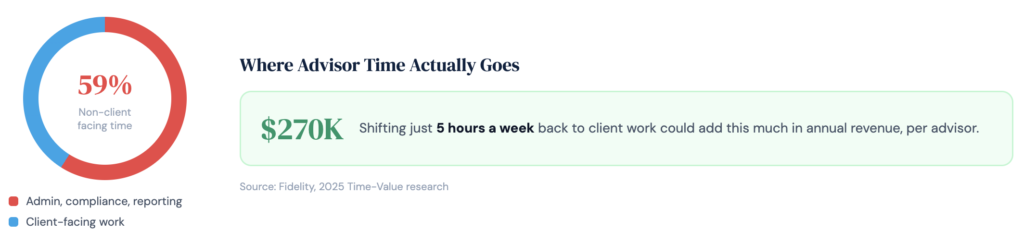
According to Fidelity’s 2025 Time-Value research, advisors spend close to 59 percent of their time on tasks that are not client-facing. That includes admin work, compliance checks, and manual reporting.
None of that time scales well as a firm adds clients. It was never built to scale in the first place. Fidelity also found something worth noting. Shifting just five hours a week back toward client work could add $270,000 in annual revenue, per advisor. That is not a small number. That is the real cost of a growth ceiling, sitting quietly inside your firm’s calendar every single week.
The Real Bottleneck Is Usually Operational
Here is a pattern seen across the RIA industry. A process that works fine at $100 million in assets often breaks by $300 million or $500 million. That happens unless someone goes back and redesigns it.
Why does this happen? Most firms build their processes once, early on. They rarely revisit them. The CRM setup from year one. The reporting spreadsheet from year two. The onboarding checklist nobody has touched since. All of it still technically works. None of it was built for the firm you are today.
Five Signs You Are Approaching a Growth Ceiling
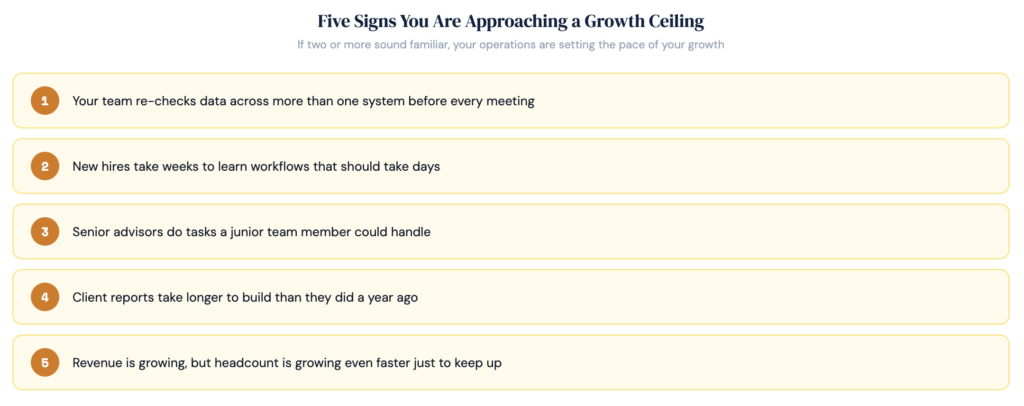
- Your team manually re-checks data across more than one system before every client meeting
- New hires take weeks to learn workflows that should take days
- Senior advisors are doing tasks a junior team member could do, simply because no clear process exists
- Client reports take longer to build than they did a year ago, even though the format has not changed
- Your firm has grown in revenue, but headcount has grown faster, just to keep up
If two or more of these sound familiar, it’s likely your operations, not your client list are limiting your firm’s growth.
Why Hiring Alone Rarely Fixes It
The instinct, when work piles up, is to hire. Add an associate. Add an analyst. Add someone to handle the overflow. This helps for a while. But it does not fix the underlying issue. If the process is slow, adding people to it just means more people working slowly. The ceiling moves a little higher. It does not disappear.
Firms that break through a growth ceiling cleanly do something different first. They fix the process. Only then do they hire, into a system that already works.
What Breaking Through the Ceiling Looks Like
A firm that has broken through its growth ceiling does not look dramatically different on the surface. The team size might be similar. The client list might be similar.
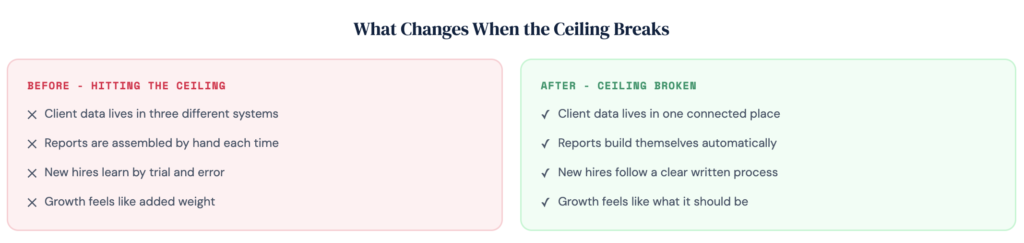
What changes is underneath. Client data lives in one place, not three. Reports build themselves instead of being assembled by hand. New hires follow a clear, written process instead of learning by trial and error.
Growth, at that point, stops feeling like added weight. It starts to feel like what it should always have been: more clients, served well, without the firm quietly straining at the seams.
A Few Quick Questions Advisors Ask Us
- What is a growth ceiling, exactly?
It is the point where a firm’s operations cannot keep pace with its client growth. The clients are there. The systems cannot serve them fast enough. - Does this only affect larger firms?
No. It can show up as early as $100 million in assets under management. It tends to repeat at each new stage of growth unless processes are revisited. - What is usually the fastest fix?
Reviewing where time is actually going each week, then fixing the one or two workflows causing the most friction, rather than trying to fix everything at once.
Next week in this series: Five specific symptoms that tell you your firm’s technology has quietly turned from a tool into an obstacle.
About Enzigma Solutions
Enzigma works with independent wealth advisory firms and Registered Investment Advisors across the United States to fix the operational bottlenecks that quietly cap growth. If these challenges sound familiar, learn how Enzigma helps wealth advisory firms streamline operations and unlock growth.