
The Hidden Cost of Disconnected Software for Advisors
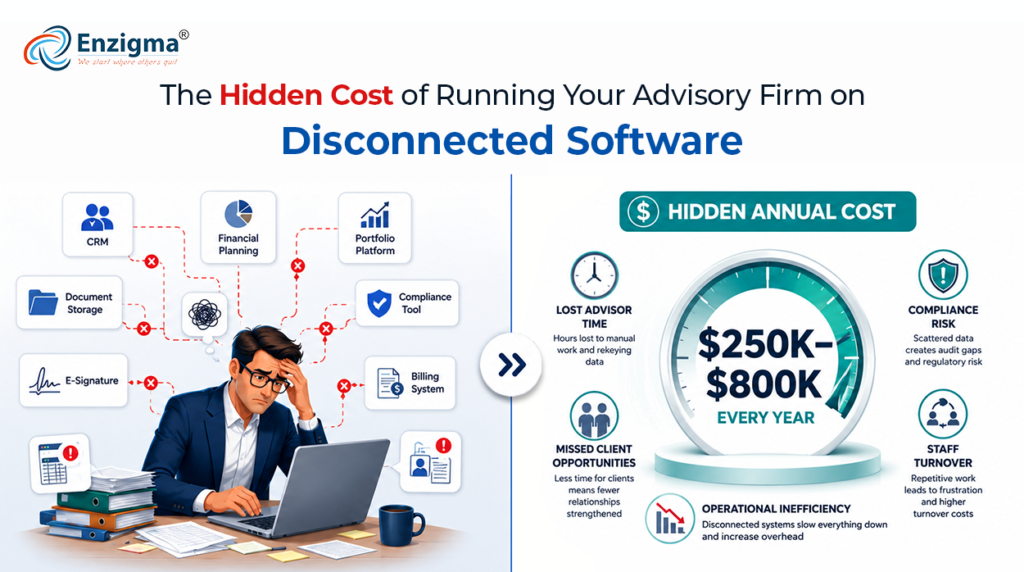
Your firm pays for six or seven different software tools. A CRM. A planning tool. A portfolio platform. Document storage. An e-signature tool. Maybe a billing system too.
Each tool does its job well on its own. The trouble starts the moment data needs to move from one tool to another.
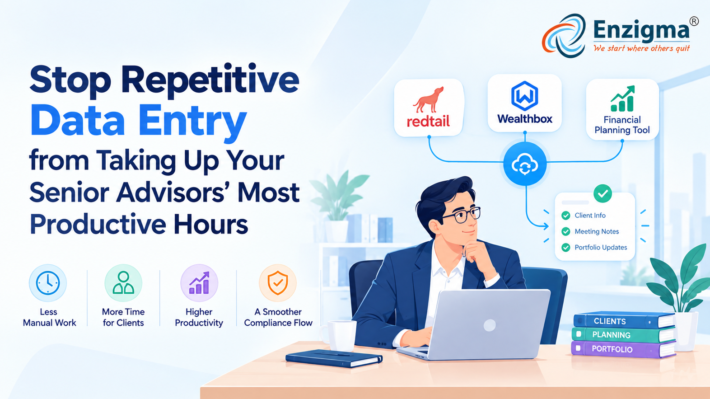
Right now, that movement happens by hand. Someone copies a number. Someone re-types a client update. Someone checks two systems just to make sure they match.
This is what disconnected software actually costs your firm. It rarely shows up as one expense on one invoice. It hides inside payroll. It hides inside staff turnover. It hides inside the client meetings that never happened because someone was stuck doing data entry instead.
Quick Answer
Disconnected software costs the average advisory firm somewhere between $250,000 and $800,000 a year. This includes lost advisor time, client experience gaps, compliance risk, and higher staff turnover. Most firms never see this number because it never lands on a single invoice.
The Cost You Can Already See
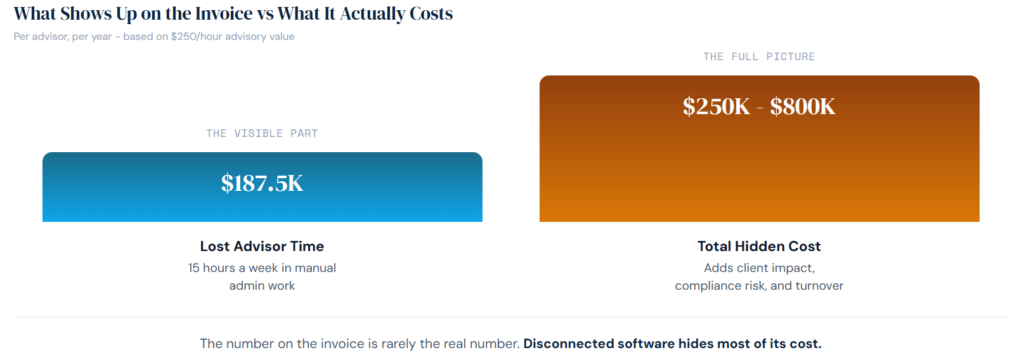
We covered this in the first article in this series: the average advisor loses close to 15 hours a week to manual admin work caused by disconnected software. At $250 an hour, that works out to $187,500 a year, per advisor.
That number alone is enough to get anyone’s attention. But it is only the visible part of the cost.
Why This Gets Worse As Your Firm Grows
Every new client adds a small amount of coordination work across your systems. On its own, that is manageable.
The problem starts when new software tools are added. A risk tolerance platform here. A tax planning add-on there. Each one solves a real problem. But each one also creates another point where data has to move by hand.
Over time, that complexity compounds. This is why firms that felt comfortable at $100 million in assets under management often start to feel real strain at $300 million or $500 million. The client count grew. The tool count grew faster. And the cost of disconnected software grew faster than both.
The Cost Hiding Underneath
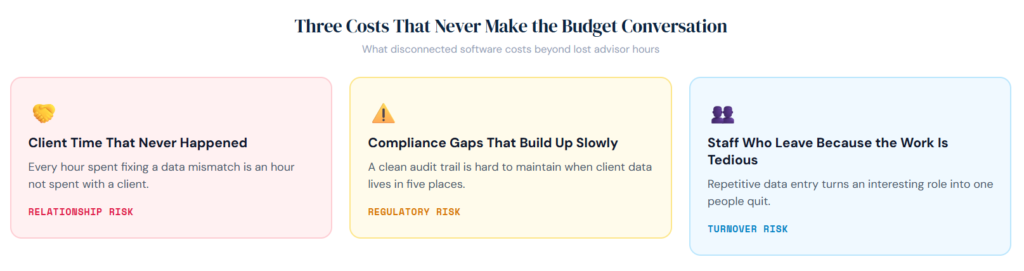
Disconnected software creates three more costs that rarely make it into any budget conversation.
- Client time that never happened. Every hour an advisor spends fixing a data mismatch is an hour not spent with a client. Over a year, that adds up to missed check-ins, delayed follow-ups, and clients who quietly feel less looked after.
- Compliance gaps that build up slowly. When client data lives in five different places, a clean audit trail takes real effort to maintain. Rebuilding that trail after the fact, during an SEC or FINRA review, is harder still.
- Staff who leave because the work is tedious. Most operations staff did not take the job to spend their week copying data between systems. Disconnected software turns an interesting role into a repetitive one, and repetitive roles see more turnover.
Five Signs Disconnected Software Is Already Costing You
- Your team re-enters the same client information in more than one system
- Quarterly reports take more than an hour per client to put together
- Nobody can say for certain which system holds the most current client record
- Compliance documentation gets assembled after the fact instead of in real time
- More than one person has mentioned that the systems do not talk to each other
If two or more of these sound familiar, disconnected software is already creating real cost inside your firm.
Why the Software Itself Is Rarely the Problem
Here is something most firms get wrong. They assume the fix is buying a better tool.
Research on advisor technology backs this up. Advisors consistently rate their individual software tools higher than they rate how well those tools work together as a system.
In other words, the planning software is fine. The CRM is fine. The real problem sits in the gap between them, not in the tools themselves.
What This Actually Costs Your Firm Each Year
Add up the real costs. Fifteen hours a week of lost advisor time comes to about $187,500 per advisor per year. Then add missed client touchpoints, compliance corrections, and the cost of replacing an operations hire who leaves early.
For a firm with four to ten advisors, this can add up to between $250,000 and $800,000 a year.
That is not an estimate pulled from thin air. It is the result of everyday costs caused by disconnected software inside many independent advisory firms.
How This Adds Up at Different Firm Sizes
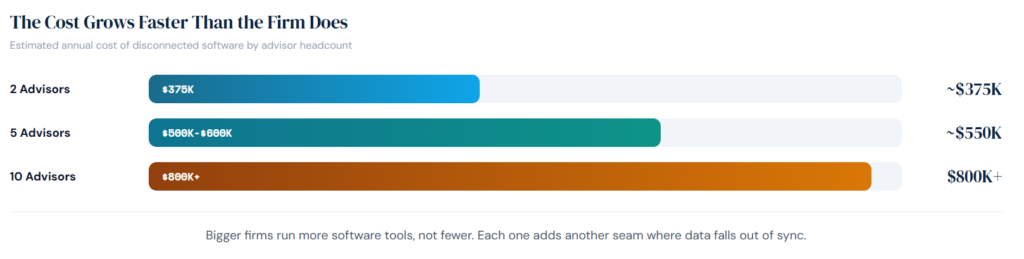
A two-advisor firm typically loses somewhere around $375,000 a year once lost time, client impact, and turnover risk are added together.
A five-advisor firm typically lands closer to $500,000 to $600,000 a year, since the coordination burden grows faster than headcount.
A ten-advisor firm often crosses $800,000 a year. Larger firms tend to run more software tools, not fewer. Each additional tool adds another seam where data can fall out of sync.
The pattern holds across firm sizes. The bigger the firm, the bigger the gap. What disconnected software quietly costs rarely shows up on any single budget line.
What Changes Once the Tools Are Actually Connected
A connected technology stack does not mean replacing what you already use. Most firms already own the right tools.
What changes is the layer between them. Client data updates once and flows everywhere it needs to go. Reports build themselves from existing data instead of being assembled by hand. Compliance records get created automatically as work happens, instead of being reconstructed weeks later.
This is the shift we walked through in detail in the first article in this series.
A Few Quick Questions Advisors Ask Us
- How much does disconnected software actually cost an advisory firm?
Most independent firms lose between $250,000 and $800,000 a year. That number combines lost advisor time, client impact, and compliance risk.
- Is the fix to buy new software?
Usually not. Most firms already have strong individual tools. The fix is connecting them, not replacing them.
- How long does it take to see a difference?
Most firms notice meaningful time savings within the first few weeks of properly connecting their existing systems.
Next week in this series: we look closely at the one tool every firm already owns and barely uses to its full potential, the CRM.
About Enzigma Solutions
Enzigma works with independent wealth advisory firms and Registered Investment Advisors across the United States to connect, configure, and automate the technology they already have. If the numbers in this article are resonating with something you have been feeling inside your firm, more details about our approach are available on the Enzigma WealthTech Solution.

Great content! Keep up the good work!
Thanks!