What a Connected Technology Stack Looks Like
Two advisory firms can look almost identical on paper. Similar assets under management. Similar number of advisors. Similar client base.
Yet one firm wins new clients consistently. The other struggles to explain why growth has stalled. The difference, more often than you would expect, comes down to one thing: a connected technology stack.
Quick Answer
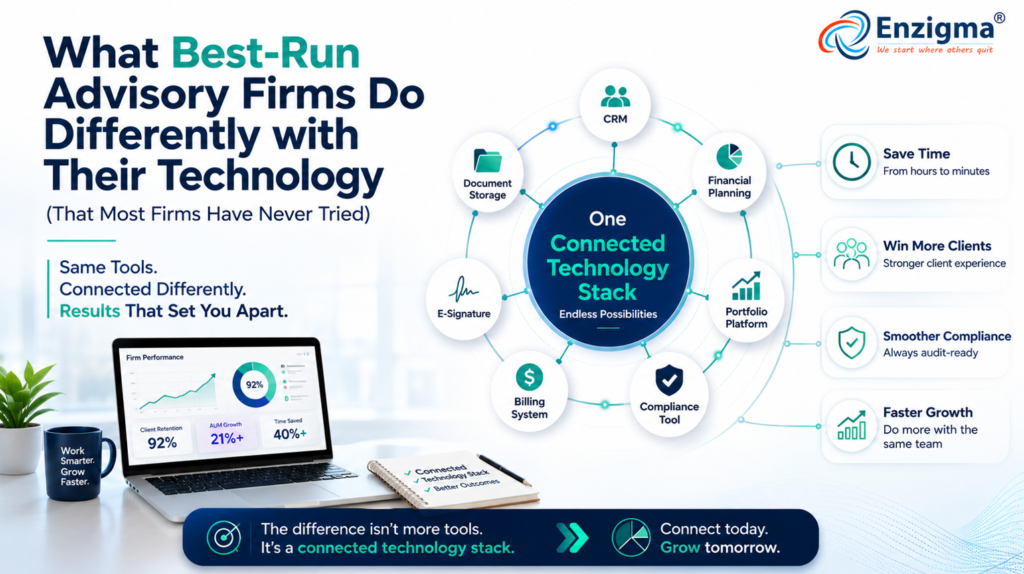
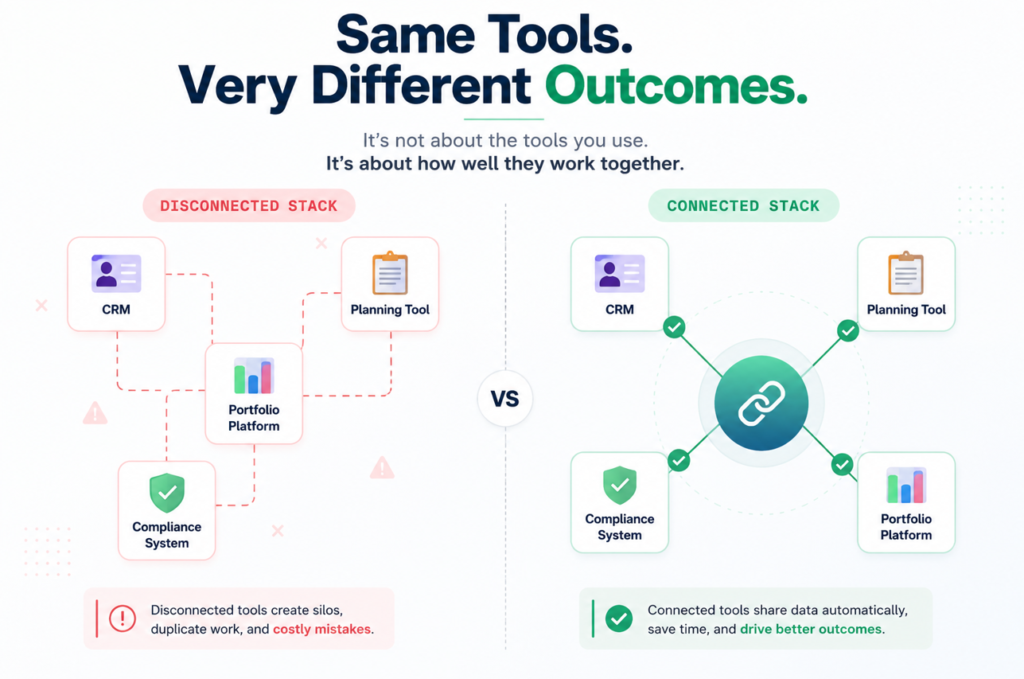
A connected technology stack means your CRM, planning tool, portfolio platform, and compliance system all share data automatically. Nobody has to move that data by hand. Firms with a genuinely connected technology stack report stronger client retention and faster growth. They also make fewer costly mistakes than firms running the same tools in isolation.
The Tools Are Rarely the Difference
Here is something that surprises most firms. The best-run advisory firms are usually not using dramatically different software than everyone else.
Many of them use the same CRM platforms. The same planning tools. The same custodians. What separates them is not which tools they bought. It is whether those tools were ever properly connected to each other.
What a Connected Technology Stack Actually Means
A connected technology stack is simple to describe, even though it takes real work to build. When a client’s information changes in one system, it updates everywhere else automatically. Nobody re-types it. Nobody checks two screens to make sure they match.
This sounds small. In practice, it changes almost everything about how a firm runs day to day.
The Advisors Who Have It, Win More Often
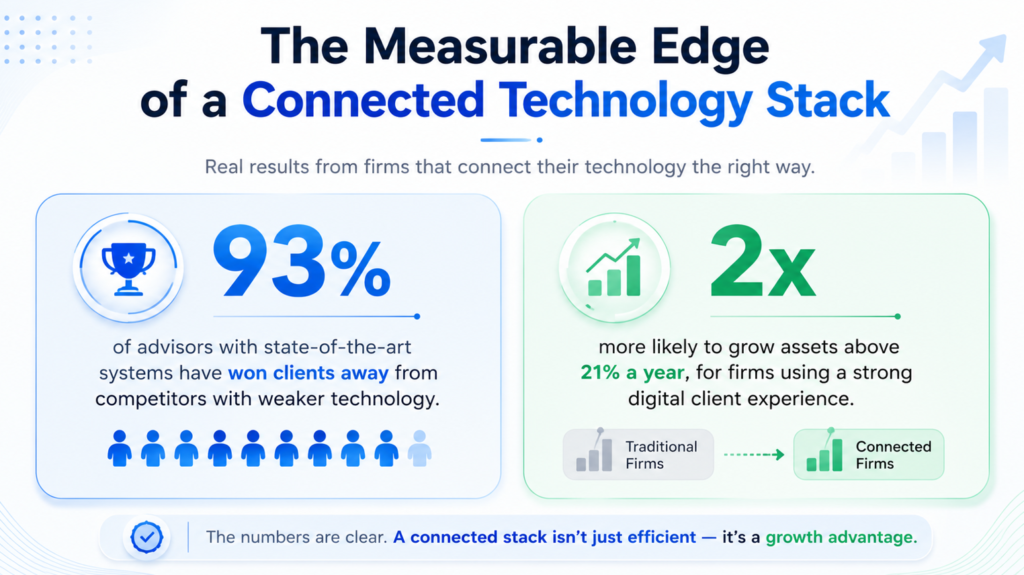
According to recent industry data, 93 percent of advisors using state-of-the-art systems reported winning clients away from competitors running on weaker technology. That is not a small edge. That is most of the market telling you the same thing.
The same research found something else. Firms using platforms built for a strong digital client experience were more than twice as likely to grow assets above 21 percent a year.
A connected technology stack is not just an operations upgrade. It is a genuine growth advantage, visible in the numbers.
Three Things Best-Run Firms Do Differently
-
- Inside a connected technology stack, the CRM sits at the center of the firm, not as a separate contact list. Every other system pulls from it and updates it automatically, instead of living as a separate island.
- They review their technology setup at least once a year. A connected technology stack does not stay connected forever on its own. Firms that revisit their setup regularly catch small gaps before they become expensive ones.
- They measure time, not just tools. Instead of asking “do we have the right software,” they ask “how much time is our team actually spending on manual work this month.” That single question tends to surface problems faster than any software review.
Why This Is Hard to Build Alone
None of this requires replacing your existing tools. Most firms already own what they need. What is usually missing is the configuration work: setting up the connections, mapping the data fields, and testing that everything actually flows the way it should.
This work takes real knowledge of both wealth management and software, together. That combination is rare to find in-house at a small or mid-sized firm. This is exactly why many firms bring in outside help to build it properly the first time.
What Changes Once the Stack Is Connected
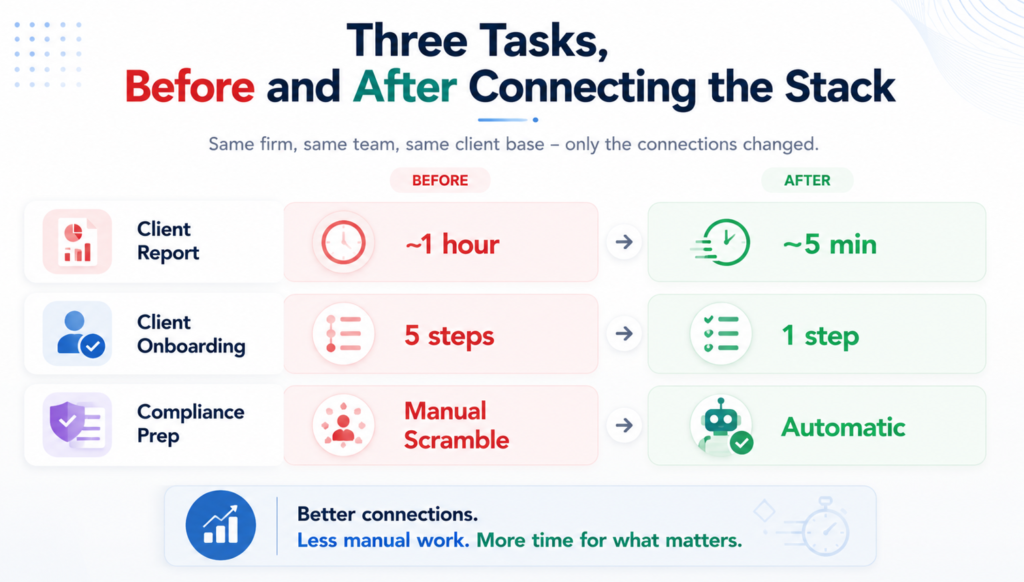
Reports that took an afternoon now take minutes. New client onboarding becomes one smooth process instead of five separate steps. Compliance documentation builds itself quietly, instead of becoming a scramble before every review.
None of this requires a bigger team. It requires the team you already have, spending their time on work that actually grows the firm.
A Few Quick Questions Advisors Ask Us
-
- Do we need new software to build a connected technology stack?
Usually not. Most firms already have strong individual tools. The work is in connecting what you already have, not replacing it. - How long does it take to connect a typical stack?
It depends on how many systems are involved, but most firms see meaningful results within a few weeks of starting the configuration work. - Is a connected technology stack only worth building for larger firms?
No. Smaller firms often see the benefit fastest, since fewer systems usually means a quicker, cleaner setup.
- Do we need new software to build a connected technology stack?
This wraps up our look at what separates firms that grow smoothly from firms that quietly struggle. Next in this series, we move from the big picture into practical, step by step guides you can use inside your own firm.
About Enzigma Solutions
Enzigma works with independent wealth advisory firms and Registered Investment Advisors across the United States to build exactly this kind of connected technology stack, using the tools firms already own. See how Enzigma helps firms connect their existing technology to create a more efficient operation.